A slip and fall in a store usually happens in a split second: a puddle near the freezer case, a crushed grape in produce, or a wet entryway on a rainy afternoon.
What happens in the next few minutes, before you leave the building, can affect how much evidence is available to prove what happened.
Florida has a statute written specifically for falls on spills and debris inside businesses, and it sets a higher bar than many shoppers expect. Knowing how that law works helps you protect a claim while the evidence is still on the floor.
If you were hurt in a store in Coral Springs or elsewhere in Broward, Palm Beach, Miami-Dade County, or the entire State of Florida, a free consultation can help you understand whether the store may be responsible.
Key Takeaways About Florida Slip and Fall Cases
- Florida's transitory foreign substance statute requires a shopper who slips on a spill or debris to prove the store had actual or constructive knowledge of it.
- Constructive knowledge can be shown by how long the substance was on the floor or by how regularly that kind of hazard occurred.
- Falls on permanent conditions, such as broken flooring or a damaged mat, are judged under the store's general duty of care.
- The store, its landlord, and outside contractors can share responsibility for the same fall.
- Stores control their own video and incident reports, so prompt preservation requests matter.
Quick Answer: Who Is Liable for a Slip and Fall in a Store in Florida?
The store can be liable if it knew, or should have known, about the spill or hazard and failed to clean it up or warn customers. Under Florida law, the injured shopper has to prove that knowledge.
What Counts as a Transitory Foreign Substance?
A transitory foreign substance is something temporary on the floor that does not belong there. The statute does not define the phrase, but in everyday terms it covers spilled drinks, dropped produce, melted ice, leaking packages, and similar debris.
The distinction matters because section 768.0755 applies only to slips on these substances in a business establishment. Other hazards are evaluated under the store's broader duty to keep the premises reasonably safe, which the statute expressly leaves in place.
| Type of hazard | Examples in a store | How the claim is evaluated |
|---|---|---|
| Transitory foreign substance | Spilled soda, a dropped yogurt, water from melting ice, grapes in the produce aisle | The shopper must prove the store had actual or constructive knowledge of the hazardous condition |
| Permanent or structural condition | Cracked tile, an uneven threshold, a curled entry mat, poor lighting | The store's general duty to maintain the premises and warn of hidden dangers |
| Condition created by the store | An employee's mop water, a pallet left in an aisle, a display placed in a walkway | The statute can still apply, but proof that an employee created the condition can show the store knew about it |
How the 2010 Statute Changed Store Fall Cases
Section 768.0755 took effect in 2010 and replaced an earlier Florida statute that did not require shoppers to prove the business knew about the substance. The current law now puts proof of actual or constructive knowledge back at the center of these cases, and makes it much harder for the injured party to successfully bring a claim. A shopper who can show how long a spill sat, or how often it recurred, is in a very different position from one who can show only that the floor was wet.
Many store falls involve more than one category, such as a leaking freezer case that leaves water on a worn floor. Identifying the exact hazard early helps decide which rules apply.

How Do You Prove the Store Knew About the Spill?
You prove the store knew about a spill either by showing an employee was aware of it or by showing the store should have found it through reasonable care. Many transitory foreign substance cases rely on the second option, called constructive knowledge.
Signs a Spill Sat There for a While
Under the statute, constructive knowledge can be shown with circumstantial evidence that the condition existed long enough for the store to discover it. In grocery and retail settings, that evidence often includes:
- Shopping cart tracks or footprints running through the spill
- Dirt, dried edges, or a sticky film suggesting the liquid had been there for some time
- A spill located near a register, deli counter, or other spot staffed by employees
- Store video showing customers walking around or through the hazard before the fall
A photo taken before the floor is cleaned can preserve several of these details at once, which is why the first few minutes matter so much.
Hazards That Keep Coming Back
The statute also allows proof that the condition occurred with regularity and was therefore foreseeable. A freezer case that leaks every afternoon, a ceiling leak that was not properly fixed, a produce mister that wets the floor, or an entrance that floods whenever it rains can show the store had reason to expect the problem.
Who Else Might Share Responsibility for a Store Slip and Fall?
The retailer is often the main defendant, but other companies may share responsibility for the fall. Depending on the facts, that can include:
- The company that operates the store and employs its staff
- The property owner or landlord, when the hazard came from a roof leak, plumbing, or another part of the building it maintains
- An outside cleaning or floor-care company that waxed, mopped, or maintained the floor
- A vendor or distributor whose employees stock shelves or coolers in the store
- A maintenance contractor responsible for refrigeration units or ice machines
Each party's share matters because Florida's comparative fault law generally assigns damages by percentage of fault rather than making one defendant pay for all of it. Identifying every responsible party early can make a real difference in what an injured shopper can recover.
Stores sometimes try to shift blame to a company that is not part of the lawsuit, such as a cleaning vendor. Under the same statute, a defendant who wants a jury to assign fault to a nonparty must formally raise that defense and prove the nonparty's fault at trial.
What to Do After a Slip and Fall in a Store
The steps you take before leaving the store protect evidence the store will otherwise control. If you are able, many shoppers find these steps helpful:
- Tell a manager what happened and ask that an incident report be completed. Make sure to properly note the store's hazardous condition on the report, and take a photo of it before you give it back to the manager. Often, the store will refuse to give you a copy of the report to protect their own interests.
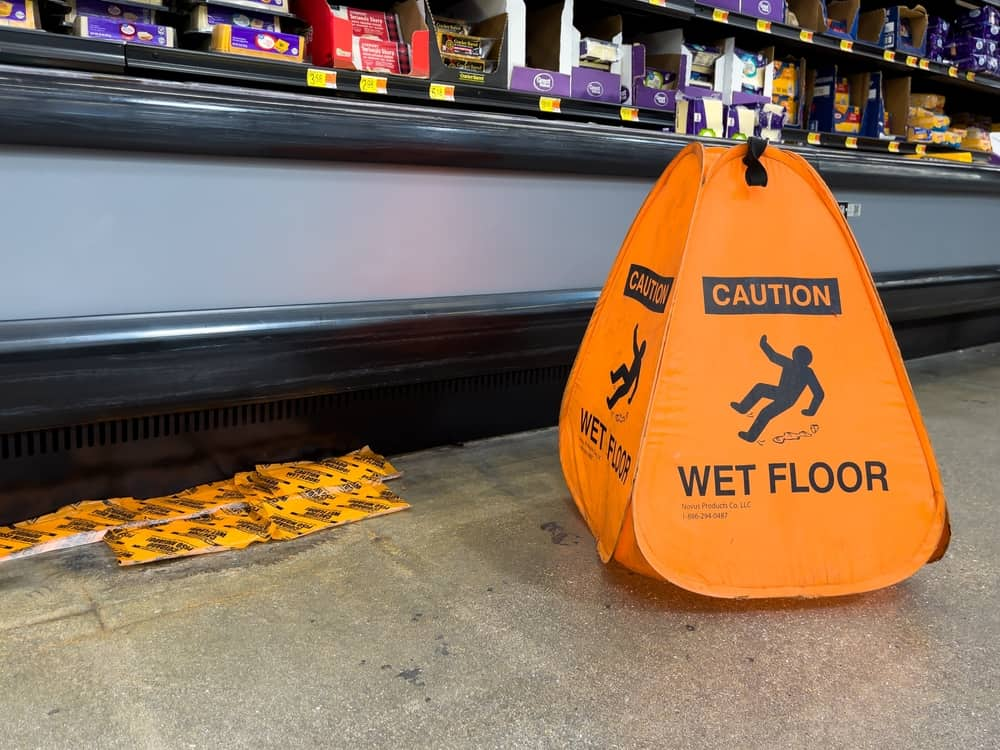
- Photograph and/or video the floor where you fell before it is cleaned, along with any warning signs or the lack of them
- Ask the names of the employees who responded and of any customers who saw the fall
- Look for cameras near the spot and note where they are
- Keep your receipt, which shows you were a customer and helps pin down the time
- Get the necessary medical care, even if you feel well enough to drive home
When describing the fall for the report, stick to what you saw and felt rather than guessing at fault. Statements like "I should have been watching" can show up later as evidence against you.
Store Video and Incident Reports: Why Timing Matters
Store video and incident reports are often the most important evidence in a grocery store fall, and the store holds both. Asking for them to be preserved quickly protects evidence that may otherwise be lost.
Surveillance Footage
Many stores record over their footage on a regular schedule unless someone asks them to keep or preserve it. A written preservation request sent soon after the fall asks the store to save video of the area, including the time before the fall that may show how the hazard got there.
Sweep Logs and Employee Schedules
Many stores keep records of when aisles were inspected or cleaned and which employees were working each area. Those records can show whether anyone checked the spot in the hour before your fall, which goes directly to whether the store should have found the hazard.
The Store's Incident Report
Stores usually keep the incident report for their own records and may not hand you a copy at the scene. Writing down the report number, the manager's name, and the date gives you a way to reference it later. You can also try to take a photo of the incident report before you give it back to the manager.
What Happens After You Report a Grocery Store Slip and Fall?
After you report a grocery store slip and fall, the claim is usually handed to an insurance adjuster or a claims administrator working for the store. That person's job is to evaluate the store's exposure, which is different from evaluating what you need to recover.
Calls From the Store's Claims Adjuster
Adjusters often call within days to request a recorded statement and authorization to collect your medical records. You can ask questions before agreeing to either, and you can decline a recorded statement to the store's insurer while you get advice. We recommend not speaking to the adjuster before you seek advice of counsel.
Early Settlement Offers
Some stores or their insurers make a quick offer to cover an emergency room bill in exchange for a signed release.
A release usually ends the entire claim, including injuries that become clearer weeks later, so it is worth understanding the full picture of your medical care before signing anything.
There is rarely a reason to accept an offer on the day it is made. Asking for the offer in writing gives you time to seek legal advice from a personal injury attorney and review it without pressure.
The Two-Year Filing Deadline
Most store slip and fall claims in Florida must be filed within two years of the fall under section 95.11. That period was shortened from four years by the 2023 reforms, so older advice about having more time no longer applies to recent falls.
FAQs About Grocery Store Slip and Fall Cases in Florida
Is a slip and fall at Walmart or Publix handled differently than at a smaller store?
The same Florida law applies to a slip and fall at a large chain and at a neighborhood market. Large retailers often route claims through a corporate claims department or an outside administrator, so the process may feel more formal, but the legal standard does not change.
Can I sue a store if I tripped over merchandise in the aisle?
Possibly. A box, display, or fallen item left in a walkway can support a claim against a Florida store, and whether the transitory substance statute or the general duty of care applies depends on what was on the floor and how it got there.
What if the store had a wet floor sign out?
A wet floor sign does not automatically defeat a claim against a Florida store. Where the sign was placed, whether it was visible from your path, and whether the hazard extended beyond it can all matter, though the store may argue the warning shifts some fault to you.
Can a store employee sue the store for negligence after slipping at work?
Usually not. Florida's workers' compensation law generally makes workers' compensation the employee's remedy against the employer, though an employee may have a separate claim against another company, such as an outside cleaning contractor, that caused the hazard.
Does it matter if I fell in the parking lot instead of inside the store?
Yes. A fall in a store parking lot may involve a different responsible party, because the shopping plaza owner or a property management company often controls the lot, and hazards like potholes or poor lighting are judged under the general duty of care.
Take the Next Step After a Florida Store Slip and Fall
If you were hurt in a store, the first question is whether the business had enough notice of the hazard to prevent the fall. That answer often depends on details such as where the hazard came from, how long it was there, and what the store knew before you were injured.
Cindy Goldstein Law helps people in Coral Springs and throughout Broward, Palm Beach, and Miami-Dade counties evaluate those facts and understand their options. Free consultations are available, and every client receives attorney Cindy Goldstein's personal email address.
Call (954) 346-5420 to discuss your store or grocery store slip and fall.
CALL 1-844-4LADYLAW or (954) 346-5420
Hablamos español | Nós falamos português | Nou pale Kreyòl