When does a concussion become post-concussion syndrome in Florida, and how does it affect compensation?
Post-concussion syndrome (PCS) occurs when concussion symptoms persist for weeks, months, or longer after the initial head injury. In Florida, a PCS diagnosis may meet the permanent injury threshold under Florida Statute § 627.737, which opens the door to pain and suffering damages beyond what Personal Injury Protection (PIP) covers.
Post-concussion syndrome can turn a seemingly "mild" concussion into a serious Florida injury claim when symptoms continue for months after a crash.
If a treating physician documents PCS as permanent, the condition may satisfy Florida's permanent injury threshold under § 627.737, allowing the injured person to pursue pain and suffering damages beyond PIP benefits.
Because PCS often does not appear on standard MRI or CT scans, compensation depends on a well-documented medical record.
Neuropsychological testing, consistent neurological care, and a clear symptom timeline are critical to proving that the crash caused lasting cognitive and neurological impairment.
Key Takeaways for Post-Concussion Syndrome Claims in Florida
- Post-concussion syndrome is diagnosed when concussion symptoms persist beyond a few months. Symptoms may include chronic headaches, cognitive fog, memory problems, mood changes, and light sensitivity.
- Florida's permanent injury threshold under § 627.737 limits pain and suffering claims. PCS that a physician documents as permanent may satisfy that threshold.
- Insurance carriers frequently dispute PCS by pointing to normal imaging or gaps in treatment. Consistent neurological documentation is the strongest counter.
- PCS claims may be valued higher than standard concussion cases because of ongoing treatment, lost earning capacity, and long-term quality-of-life impacts.
- The 14-day deadline for initial medical treatment under Florida PIP law applies even when concussion symptoms seem mild at first. If you do not seek treatment within 14 days of a motor vehicle crash, you waive your PIP benefits which typically provides up to $10,000.00 in coverage for medical care and lost wages.
What Is Post-Concussion Syndrome, and How Is It Different From a Concussion?
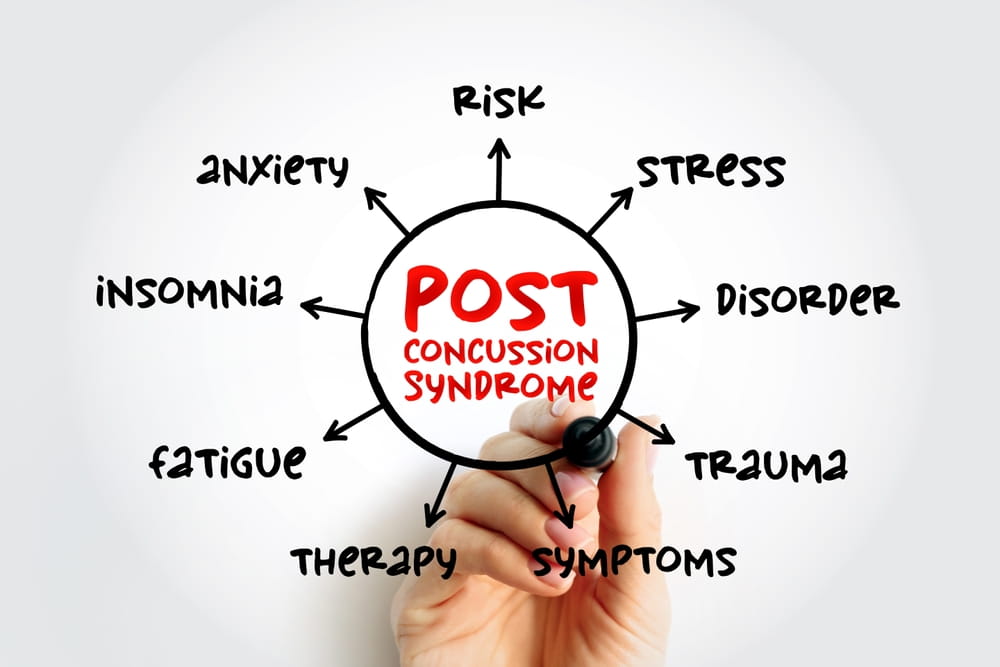
Post-concussion syndrome occurs when concussion symptoms continue for weeks, months, or even years after the original head injury.
Many concussions improve within a few weeks. When symptoms last beyond the expected recovery period, the person may need evaluation for persistent post-concussive symptoms.
PCS is often diagnosed when recovery stalls, commonly after symptoms have continued for about three months.
The National Institutes of Health describes PCS as a group of physical, cognitive, behavioral, and emotional symptoms that can follow a mild traumatic brain injury (TBI).
Common PCS Symptoms
PCS symptoms overlap with concussion symptoms but last far longer and may interfere with work, relationships, and daily function:
- Persistent headaches or migraines that do not respond to standard pain medication.
- Difficulty concentrating, processing information, or multitasking.
- Memory problems, including difficulty recalling recent conversations or tasks.
- Mood changes such as irritability, anxiety, or depression.
- Sensitivity to light and sound that limits screen use and social activity.
These symptoms are measurable through neuropsychological testing, even when MRI and CT imaging appear normal. That disconnect is one reason insurers push back so hard on PCS claims.
Why Normal Imaging Does Not Rule Out PCS
A normal MRI or CT scan does not mean the brain is uninjured. Standard imaging detects structural damage like bleeding or fractures, not the diffuse cellular-level changes that cause PCS symptoms.
Advanced imaging such as diffusion tensor imaging (DTI) may reveal white matter disruption, but it is not part of routine emergency care.
How Is Post-Concussion Syndrome Documented for a Florida Injury Claim?
PCS is documented through neurological evaluations, neuropsychological testing, and consistent medical records that trace symptoms from the initial injury forward.
| Documentation Type | What It Establishes | Who Provides It |
|---|---|---|
| Initial ER or urgent care records | Baseline injury documentation and mechanism of injury | Emergency physician or urgent care provider |
| Neurological evaluations | Clinical diagnosis of concussion and ongoing symptom tracking | Neurologist |
| Neuropsychological testing | Objective measurement of cognitive deficits in memory, processing speed, attention, and executive function | Neuropsychologist |
| Symptom journals | Daily record of headaches, cognitive episodes, sleep disruption, and functional limitations | Patient, reviewed by treating provider |
| Advanced imaging (DTI, fMRI) | Potential evidence of white matter disruption not visible on standard MRI | Neuroradiologist, ordered by treating neurologist |
| Vocational rehabilitation assessment | Impact of cognitive deficits on work capacity and future earning potential | Vocational rehabilitation professional |
Why Consistent Treatment Records Matter
Insurance carriers look for gaps in treatment as evidence that symptoms were not severe. A patient who waits six weeks between appointments gives the adjuster room to argue the injury resolved.
Consistent treatment from the first visit through the PCS diagnosis creates a timeline that is much harder to attack.
The 14-Day PIP Window and Delayed Concussion Symptoms
Florida law requires initial medical treatment within 14 days of a crash to preserve PIP benefits under Florida Statute § 627.736. Concussion symptoms sometimes feel minor in the first few days. A patient who delays past 14 days may lose PIP access entirely, even if PCS symptoms appear later.
Does Post-Concussion Syndrome Meet Florida's Permanent Injury Threshold?
PCS may meet the threshold if a treating physician opines it is permanent within a reasonable degree of medical probability.
Under Florida Statute § 627.737, pain and suffering damages require a permanent injury, significant and permanent loss of a bodily function, or significant and permanent scarring or disfigurement.
How PCS Qualifies
Cognitive function is a bodily function. When a neuropsychologist documents lasting deficits and a neurologist confirms permanency, PCS may satisfy the threshold.
The physician's language matters. Terms like "permanent within a reasonable degree of medical probability" are more useful for the legal threshold than nonspecific terms like "chronic."
When the Insurer Challenges the Threshold
Insurance carriers routinely argue that the injury is not permanent. In PCS cases, the defense often argues mechanism of injury or points to normal imaging or gaps in treatment. The strength of the medical documentation determines whether the case survives.
How Do Florida Insurers Fight Post-Concussion Syndrome Claims?

Florida insurers fight PCS claims by attacking the mechanism of injury or targeting the gap between what the patient reports and what standard tests show. Common tactics include:
- That you did not strike your head on anything in the vehicle so you could not have sustained a neurological injury.
- Arguing that normal MRI and CT scans prove no brain injury occurred.
- Pointing to treatment gaps as evidence you recovered.
- Hiring defense medical examiners who downgrade the diagnosis or attribute symptoms to pre-existing anxiety or depression.
- Contesting neuropsychological test results as unreliable.
- Offering low settlements before cognitive deficits are fully documented.
Every one of these tactics is weaker when the medical record is built correctly from the start.
What Damages May a Florida PCS Claim Include?
A Florida PCS claim may include both economic and noneconomic damages if deemed permanent. The long-term nature of PCS often pushes the value well beyond a standard concussion case.
Economic Damages
Economic damages may include past and future medical expenses for neurological care, neuropsychological treatment, cognitive rehabilitation, and medication.
Lost wages and loss of future earning capacity are often significant because PCS may prevent return to cognitively demanding work.
Noneconomic Damages
Noneconomic damages may include pain and suffering, mental anguish, and loss of enjoyment of life. PCS patients often describe feeling like a different person.
That testimony, supported by testing and treatment records, may carry significant weight with a jury.
How Does Cindy Goldstein Law Approach Post-Concussion Syndrome Claims?
We treat PCS claims differently because the medical evidence has to prove an injury that no scan shows. That requires coordination between legal strategy and the medical record from the first appointment, not after treatment is finished.
Cindy discusses cognitive symptoms with clients during the initial conversation and stays informed as treatment progresses.
She helps clients understand how each medical decision, from seeing a neurologist to pursuing neuropsychological testing, may affect claim development.
Our office is at 10100 W. Sample Road, Suite 200, Coral Springs, FL 33065. Call (954) 346-5420 or 1-844-4LADYLAW for a free consultation.
Working With Qualified Medical Providers
PCS cases depend heavily on the treating physician's documentation and credibility. We help clients identify board-certified neurologists and neuropsychologists with experience diagnosing and treating post-concussion syndrome.
The goal is not to shape or force a diagnosis but to ensure the provider who is already treating you documents your symptoms thoroughly and clearly, and strives to help you get better.
When the defense hires a medical examiner to challenge the diagnosis, detailed records from a qualified treating provider are often important evidence.
When the Insurer Says the Injury Is Subjective
PCS claims attract a specific type of pushback: the carrier argues that because the MRI is clean, the symptoms are exaggerated or psychological.
We may counter that with neuropsychological test data showing measurable cognitive deficits, a neurologist's clinical diagnosis, and a treatment timeline with no gaps for the adjuster to exploit.
Communicating About Symptoms in Your Language
Our team handles PCS cases in English, Spanish, Portuguese, and Haitian Creole so that language does not become a barrier to building a complete medical record.
Ask Cindy Goldstein Law
How long does post-concussion syndrome last?
PCS may last months, and in some cases, years. When symptoms persist beyond a year with documented cognitive deficits, a treating physician may characterize the condition as permanent for claim purposes.
Can I still file a claim if my concussion was diagnosed as mild?
Yes. A mild concussion diagnosis at the ER does not prevent a later PCS diagnosis. PCS frequently develops after concussions classified as mild at the initial visit.
How is a PCS case valued differently than a regular concussion case?
PCS cases are generally valued higher because they involve longer treatment, greater functional impairment, and potential permanent cognitive deficits. A PCS diagnosis confirmed as permanent may support claims for years of future treatment, lost earning capacity, and substantial noneconomic damages. Concussions are types of TBIs. Description of the TBI represents the extent of the brain injury.
FAQs for Post-Concussion Syndrome in Florida
Do I need neuropsychological testing to prove post-concussion syndrome?
Not always, but testing significantly strengthens a PCS claim by providing objective data on cognitive deficits that clinical evaluation alone may not capture.
What if my symptoms did not start until weeks after the crash?
Delayed onset is common with PCS. The sooner you seek treatment and document your head injury, the better for your claim.
Is post-concussion syndrome considered a permanent injury in Florida?
It depends on the medical evidence. If a physician documents PCS as permanent within a reasonable degree of medical probability, it may meet the threshold under § 627.737.
What if the insurance company says my symptoms are from stress or anxiety?
Insurance carriers commonly attribute PCS symptoms to pre-existing conditions as a defense tactic. A neuropsychologist who conducts validated testing and distinguishes PCS-related cognitive deficits from anxiety or depression provides the strongest rebuttal.
How long do I have to file a PCS injury claim in Florida?
Florida's statute of limitations for negligence-based claims from crashes on or after March 24, 2023, is two years from the date of the crash under Florida Statute § 95.11. PCS cases often involve ongoing treatment, so starting early matters for both evidence and timing.
Get Your Post-Concussion Syndrome Claim Evaluated Now
The longer PCS goes undocumented, the harder it becomes to connect symptoms to the crash. A clean CT scan at the ER does not mean the brain is fine.
It means the ER was looking for bleeds and fractures, not for the kind of injury that shows up as lost words, broken sleep, and a life that no longer feels familiar.
If symptoms have not resolved weeks or months after a crash in Coral Springs, Parkland, or anywhere in South Florida, call (954) 346-5420 or 1-844-4LADYLAW to talk through what your medical records show and what they may still need.
The information on this page is for general informational purposes only and does not constitute legal advice. No attorney-client relationship is formed by reading this content. Prior results do not guarantee a similar outcome.